The Home Advantage Cheat Sheet for Sports Bettors
A comprehensive case study and reference guide for major global leagues (data since ~2000).
In sports betting, home advantage is one of the most consistent and well-documented edges in all of sport. Across balanced leagues, research shows that home teams win well over 50% of the time, season after season. Yet many bettors still treat it as a vague narrative instead of a quantifiable variable they can plug into their models.
This article condenses findings from academic work and applied analysis into a practical cheat sheet for sports bettors.
Instead of only dumping raw percentages, we also explain why home advantage exists, how it has changed over time, and when markets tend to misprice it.
1. Core Metrics: How to Measure the Edge
To analyse home advantage like a pro, we use a few simple but powerful metrics.
- • Home Win % — share of games won by the home team.
- • Away Win % — share of games won by the away team.
- • Home Edge vs Away (pp) — Home Win % − Away Win % in percentage points.
- • Home Share of Points (football) — percentage of all league points earned at home. Research on the Big Five leagues reports an average of 60.89% of points won at home, with a peak around 62.25% in Serie A and a minimum around 58.35% in the Bundesliga.
A value of 50% home share would mean no advantage. Anything above 50% is proof that the venue systematically matters.
2. Why Home Advantage Exists: The Five Pillars
Studies in sports psychology and performance analytics consistently show that home advantage is multi-causal. No single factor explains everything, but together they create a persistent edge for the home side.
- Crowd support. Noise, chants, and emotional energy boost home players and add pressure to opponents. During COVID-19 “ghost games” in Europe, when stadiums were empty, home advantage dropped by roughly one third, a natural experiment that strongly supports the importance of fans.
- Facility familiarity. Home teams know the pitch dimensions, turf quality, lighting, sight lines and subtle quirks of their venue. In football this can mean understanding how the ball runs in certain areas; in basketball, how the rims and background look for shooting.
- Travel fatigue. Away teams often cross time zones, sleep in hotels and follow disrupted routines. Studies in the NBA, for example, show that teams travelling against their circadian rhythm underperform compared to trips aligned with their body clock.
- Territoriality and physiology. Research in football indicates that players show higher testosterone levels before home matches — especially against rivals — combined with lower pre-game anxiety. This is a classic “defending your territory” response.
- Referee bias. Multiple analyses of Premier League and European games show that referees award more 50/50 decisions, fewer cards and more penalties to home sides. Crowd noise and density, not just absolute attendance, seem to drive this effect, although technologies like VAR have reduced (not eliminated) it.
For bettors, the takeaway is clear: home advantage is not just a historical artefact. It is continuously generated by psychology, physiology, logistics and officiating in every game you bet on.
3. European Football: The "Big Five" Analysis
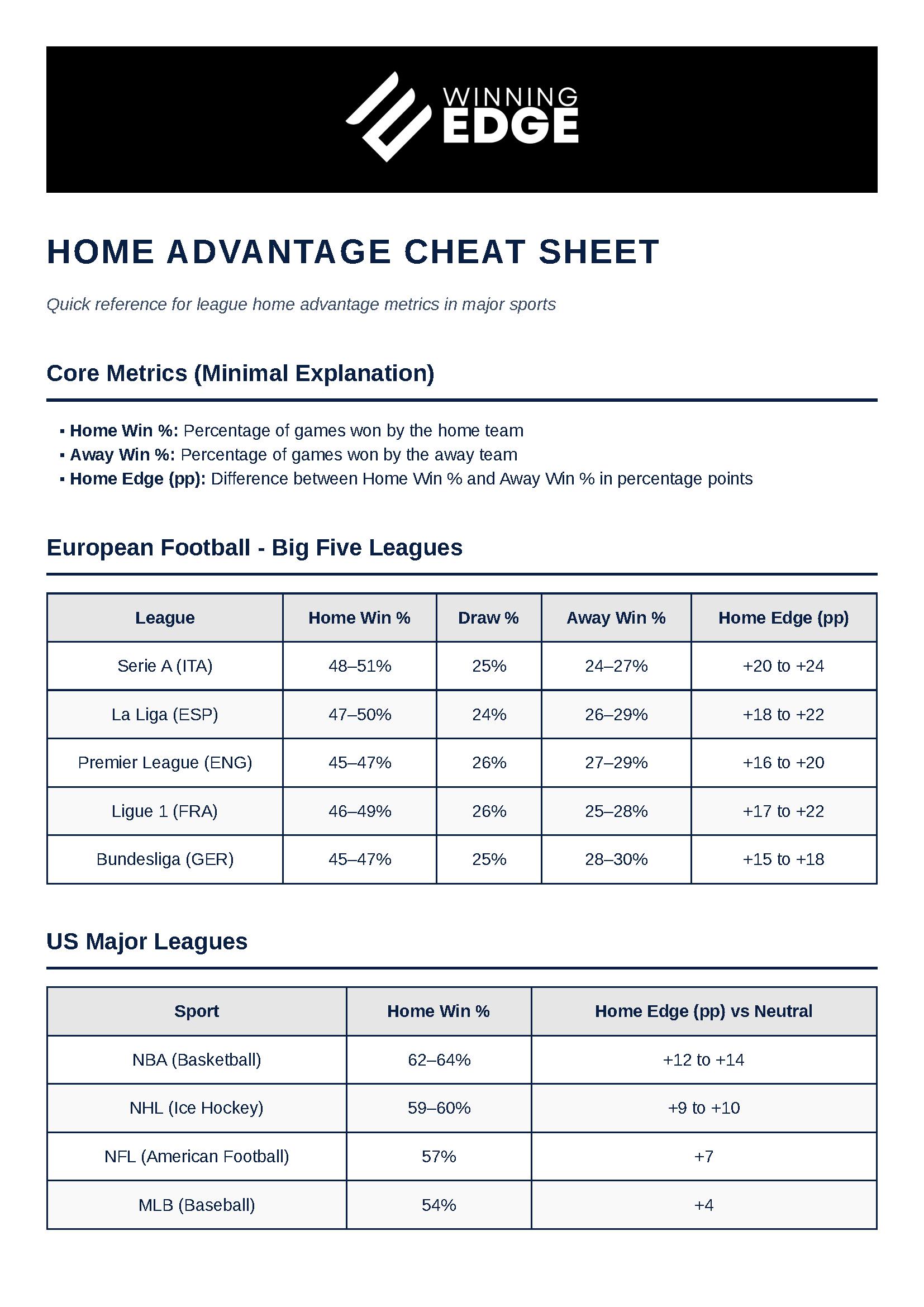
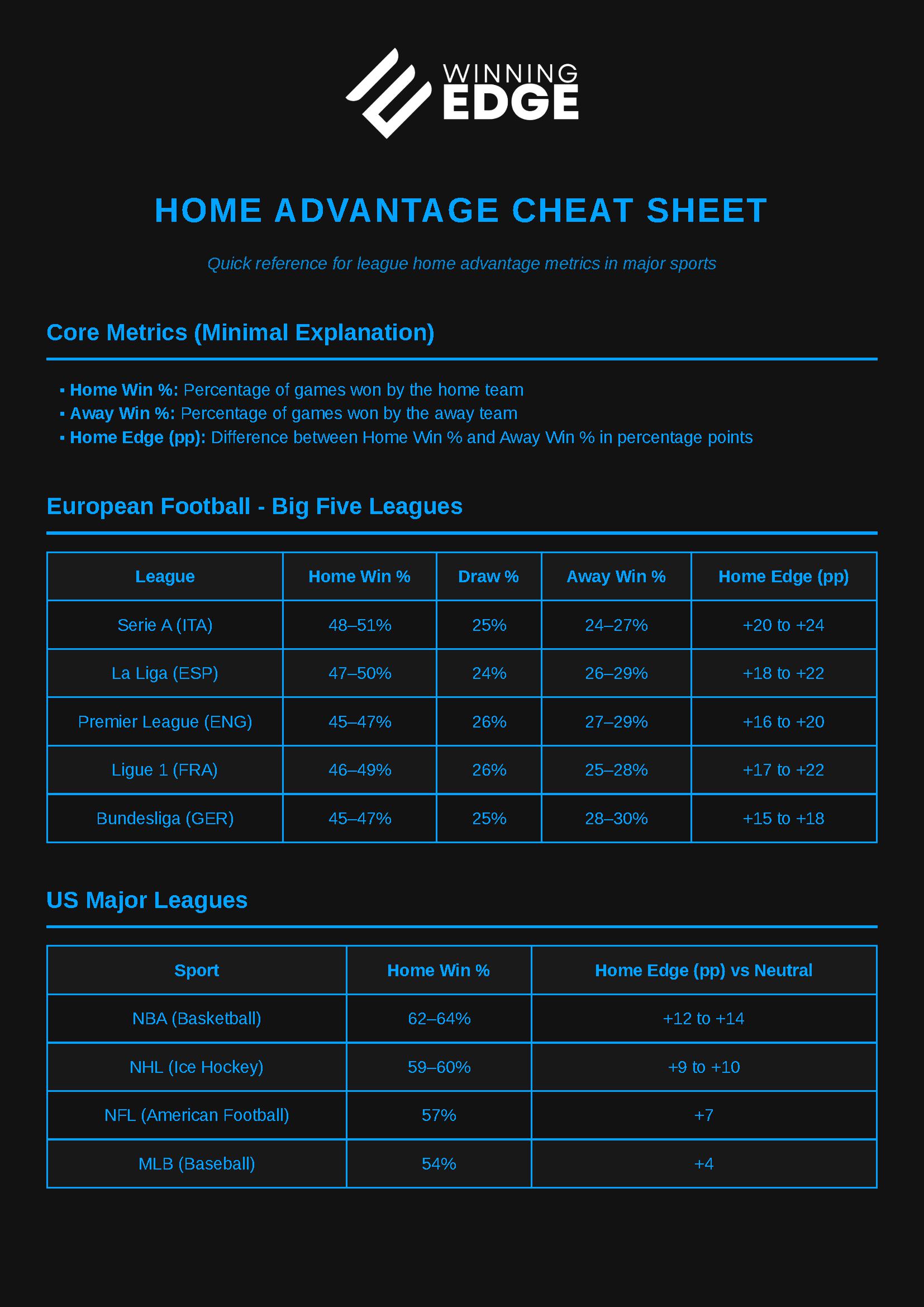
Across the Premier League, La Liga, Serie A, Bundesliga and Ligue 1, home teams typically earn about 60% of all league points. Studies analyzing decades of data report a combined average of 60.89%, with Italy at the top and Germany at the bottom of the group.
The 3-points-for-a-win rule slightly reduced overall home advantage (teams are more aggressive away when a win is worth more than a safe draw), but the effect remains strong — especially for weaker teams low in the table, who rely more heavily on their home fixtures.
| League | Home Win % | Draw % | Away Win % | Home Edge (pp) |
|---|---|---|---|---|
| Serie A (ITA) | ~48–51% | ~25% | ~24–27% | +20 to +24 |
| La Liga (ESP) | ~47–50% | ~24% | ~26–29% | +18 to +22 |
| Premier League (ENG) | ~45–47% | ~26% | ~27–29% | +16 to +20 |
| Ligue 1 (FRA) | ~46–49% | ~26% | ~25–28% | +17 to +22 |
| Bundesliga (GER) | ~45–47% | ~25% | ~28–30% | +15 to +18 |
Crucially, studies note that this advantage is not uniform across teams. Elite clubs are relatively stable home and away, while lower-ranked sides depend much more on their home fixtures. As a bettor, that means league averages should always be adjusted for team quality.
4. US Major Leagues
Research across decades of data in various sports reveals significant differences in home advantage strength:
- Baseball (MLB): Home teams win about 54.3% of games.
- American Football (NFL): around 57.3% home wins.
- Ice Hockey (NHL): roughly 59.5% home wins.
- Basketball: one of the strongest effects — approx. 64.4% home wins in some samples.
- Testosterone & territoriality. Studies on professional football players found significantly higher testosterone before home matches — up to 40–67% higher in some rivalry games. Goalkeepers in particular show large spikes, consistent with a “last line of defence” role.
- Lower anxiety at home. Players generally report less pre-match anxiety and greater confidence when playing at home, which correlates with more assertive and risk-tolerant behaviour on the pitch.
- Crowd as a performance amplifier. Fans create something like a legal form of “doping”: louder stadiums are associated with more intense pressing, more offensive setups by home coaches, and a stronger start to games. Studies even show home teams often perform best in the first 5–20 minutes, before a gradual “fizzle-out” as intensity drops.
- Across major European leagues, traditional home advantage dropped by about one third when fans were removed.
- Referees gave fewer yellow cards to away teams and slightly more to home teams, narrowing the historical gap.
- Home teams generated fewer shots and corners, while away teams changed very little — suggesting that it is the home side whose energy and aggression are most dependent on the crowd.
- Public teams at home: Heavily supported clubs (Lakers, Patriots, major European giants) often get a “fan premium” in the odds.
- Derbies and narratives: Rivalry matches where media hype the atmosphere can push home prices beyond what the underlying data supports.
- Small-sample “home fortress” runs: A team on a short hot streak at home will likely regress toward the league average over time.
- Extreme conditions: Altitude (e.g., Denver, La Paz), climate and long travel distances can add several extra percentage points on top of average home advantage.
- Lower divisions and niche leagues: Market models are weaker, travel logistics worse and local knowledge more valuable.
- Post-COVID transitions: In some leagues, markets initially underreacted to the return of full crowds, briefly undervaluing home sides.
- Download match-level data (results, venue) for your league and time period.
- Count home wins, draws and away wins.
- Compute:
- Home Win % = home wins / total games
- Away Win % = away wins / total games
- Home Edge = Home Win % − Away Win %
- For football, convert results into points (3–1–0) and measure home share of total points.
- Repeat by season, by coach, or pre/post rule changes to see how stable home advantage really is.
NBA
~62–64%
≈ +12–14% vs neutral
NHL
~59–60%
≈ +9–10% vs neutral
NFL
~57%
≈ +7% vs neutral
MLB
~54%
≈ +4% vs neutral
5. The Psychology and Physiology Behind Home Advantage
Studies highlight that home advantage is as much about brains and hormones as it is about tactics.
From a betting perspective, this helps explain why home teams sometimes start like a house on fire, only for games to even out later — useful for in-play trading concepts such as early pressure vs. late-game regression.
6. COVID, Empty Stadiums and the Declining Edge
Historically, some leagues showed very strong home advantages (e.g., >70% home wins in early decades of Spanish and Italian football). But modern data suggests a gradual decline since the late 1990s, linked to better travel, more professional officiating and more balanced competitions.
The COVID-19 pandemic gave researchers the rare chance to study matches in completely empty stadiums. The results were striking:
Once crowds returned, home advantage recovered but did not necessarily revert to decades-old levels. For bettors, this means you should treat home advantage as a moving target, not a fixed constant.
7. Strategic Betting Takeaways
When Home Advantage is OVERPRICED
When Home Advantage is UNDERPRICED
8. Building Your Own Home Advantage Numbers
To go beyond league averages, you can calculate customised home advantage values for specific competitions, time windows or team groups:
Once you have these baselines, you can compare them to implied probabilities from bookmaker odds and look for systematic mispricings.